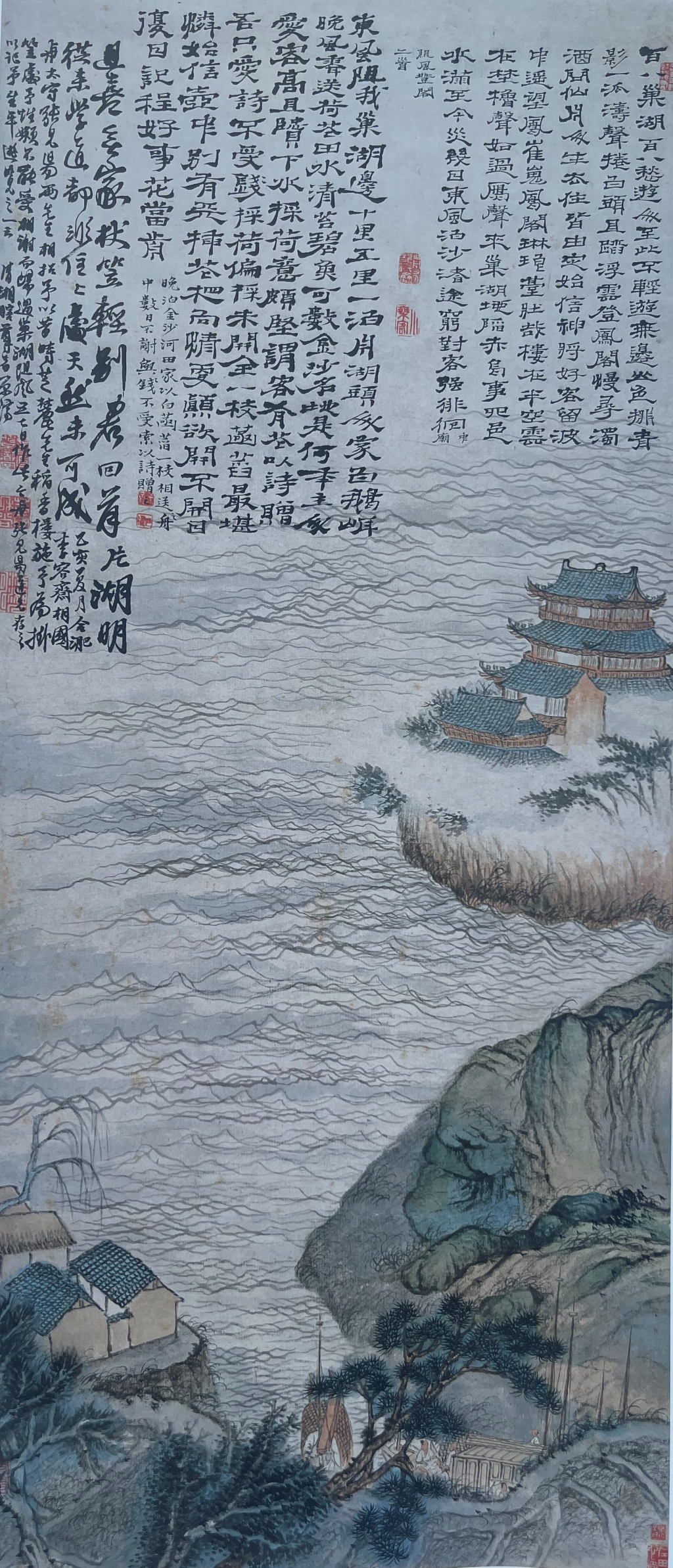
From Shi Tao's monumental 3.5-meter-high "Huangshan Landscape" from the Qing Dynasty, to Mei Qing's series of Huangshan paintings, Fang Congyi's "Cloud and Mountain Landscape" from the Yuan Dynasty, and Liu Haisu's series of large-scale Huangshan paintings—such as his masterpiece "Man Jiang Hong," painted at the age of 93—these masterpieces of Chinese landscape painting history were recently exhibited at the Liu Haisu Art Museum in Shanghai. According to ArtPulse, as a key annual academic research project of the museum, the "Landscape Painting Lineage—Liu Haisu's Ten Visits to Huangshan: Art and Education Research Exhibition" uses Liu Haisu's unique experience of climbing Huangshan ten times during his more than seventy-year artistic career as its main thread, systematically presenting the enormous influence of Huangshan on Chinese art and the profound connection between artistic exploration and educational practice.
This exhibition, a collaboration between the Shanghai Liu Haisu Art Museum and the University Museum and Art Gallery of the University of Hong Kong, is the closing exhibition of the Shanghai Liu Haisu Art Museum's 30th anniversary celebration. The exhibition features approximately 200 works and documents across four exhibition halls, showcasing the influence of Huangshan on Chinese art. It displays masterpieces created by Mr. Liu Haisu during his ten visits to Huangshan, as well as landscape paintings by renowned artists throughout history. The scale and quantity of the exhibition are both at an all-time high in recent years.
Among them, Liu Haisu's masterpiece "Man Jiang Hong," a large-scale splashed-ink painting created at the age of 93 during his tenth visit to Huangshan in 1988, and his classic oil painting "Houhai Clouds and Mist," are being exhibited on the mainland for the first time. These masterpieces were donated to the University Museum and Art Gallery of the University of Hong Kong in the 1990s. At the same time, Liu Haisu's large-scale splashed-ink Huangshan painting is also being exhibited for the first time in recent years.
Through a systematic review of ancient and modern Chinese and Western paintings, historical documents, and teaching achievements, the exhibition presents Mr. Liu Haisu's response to the cultural demands of the times in both art and education, and also reflects the historical process of Chinese art and art education's continuous exploration and innovation between tradition and modernity in the context of globalization.
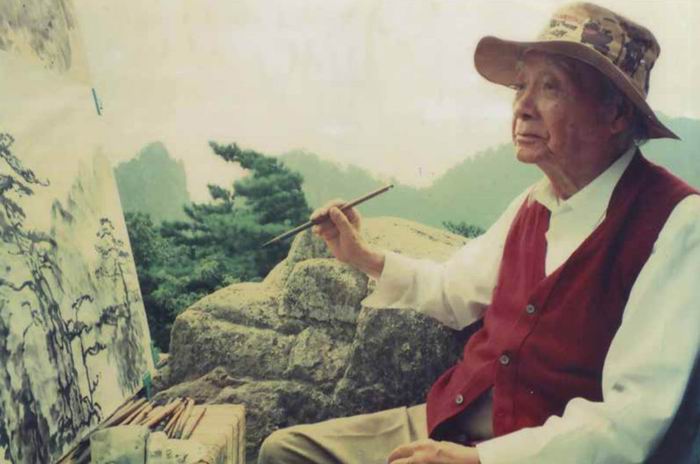
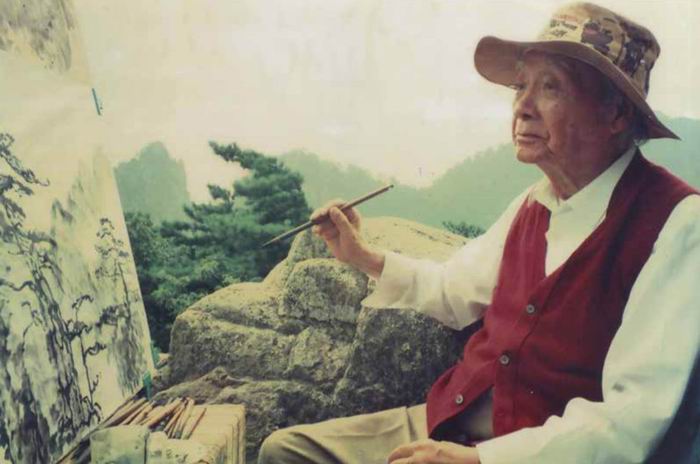
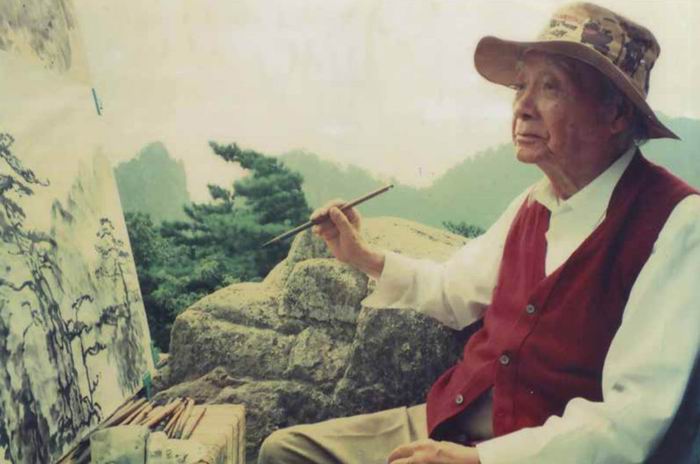
Liu Haisu (1896-1994) in Huangshan
From "Learning from Nature" to "Enlightening the People": Ushering in Modern Chinese Art Education
Liu Haisu (1896-1994) was a renowned painter, calligrapher, and founder of modern Chinese art education. Huangshan Mountain was not only an important subject in Liu Haisu's artistic creations but also a spiritual high ground for his observation of nature and understanding of the essence of art. In his continuous climbing and depiction of Huangshan, Liu Haisu integrated his personal aesthetic ideals with his educational philosophy, exploring the path of fusion between Western modern art concepts and traditional Chinese ink painting. He proposed the art education philosophy of "borrowing from the past to open up the future, integrating Western elements to enrich Chinese art," thus promoting the innovation of modern Chinese art education. Especially in the establishment and curriculum development of the Shanghai Academy of Fine Arts, Liu Haisu transformed his personal artistic pursuits into educational practice, establishing the basic framework of modern Chinese art education and profoundly influencing the development direction of 20th-century Chinese art education.
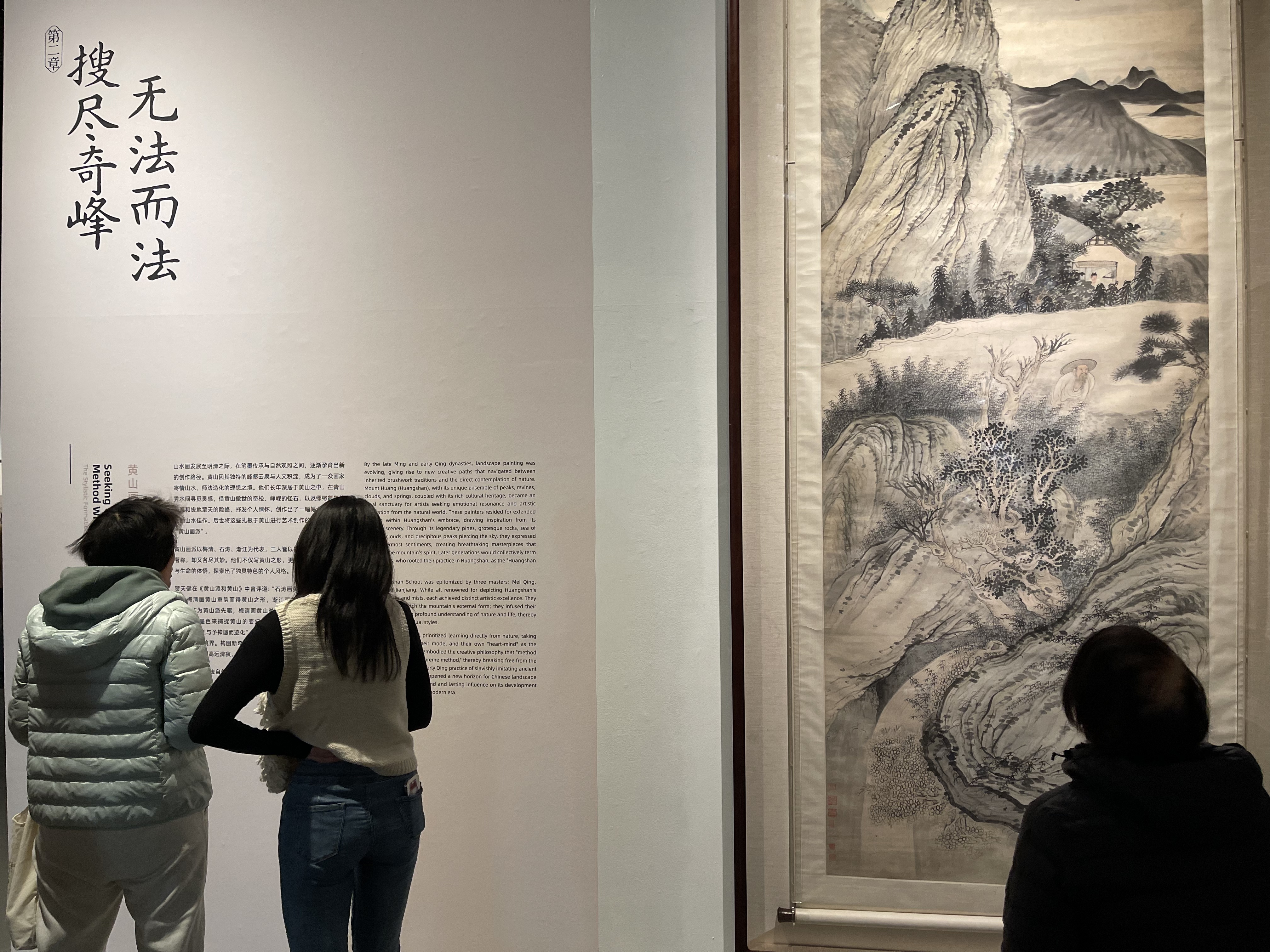
Exhibition of Shi Tao's masterpiece of landscape painting
Upon entering the exhibition hall, the first thing that catches the eye is a monumental landscape painting by Shi Tao, standing 3.5 meters tall. On this large sheet of paper, the Huangshan Mountain, as depicted by the early Qing Dynasty master Shi Tao, rises majestically from the misty ink. The towering peaks are outlined with dry brushstrokes, employing both wet and dry techniques, resulting in a powerful and vigorous style; the sea of clouds is rendered with flowing ink, creating an ethereal and dynamic effect. This "Huangshan Mountain" painting, treasured in the Liu Haisu Art Museum, is so grand in scale and so unrestrained in its brushwork that it not only captures the unique features of Huangshan, where "every peak is rock, and every rock is wondrous," but also, with its creative declaration of "searching out all the wondrous peaks to make drafts," marks a crucial turning point in Chinese landscape painting, from imitating the ancients to learning from nature. Standing before this masterpiece from three hundred years ago, the viewer can almost hear Shi Tao's cry that "brush and ink should follow the times" transcending time and space.
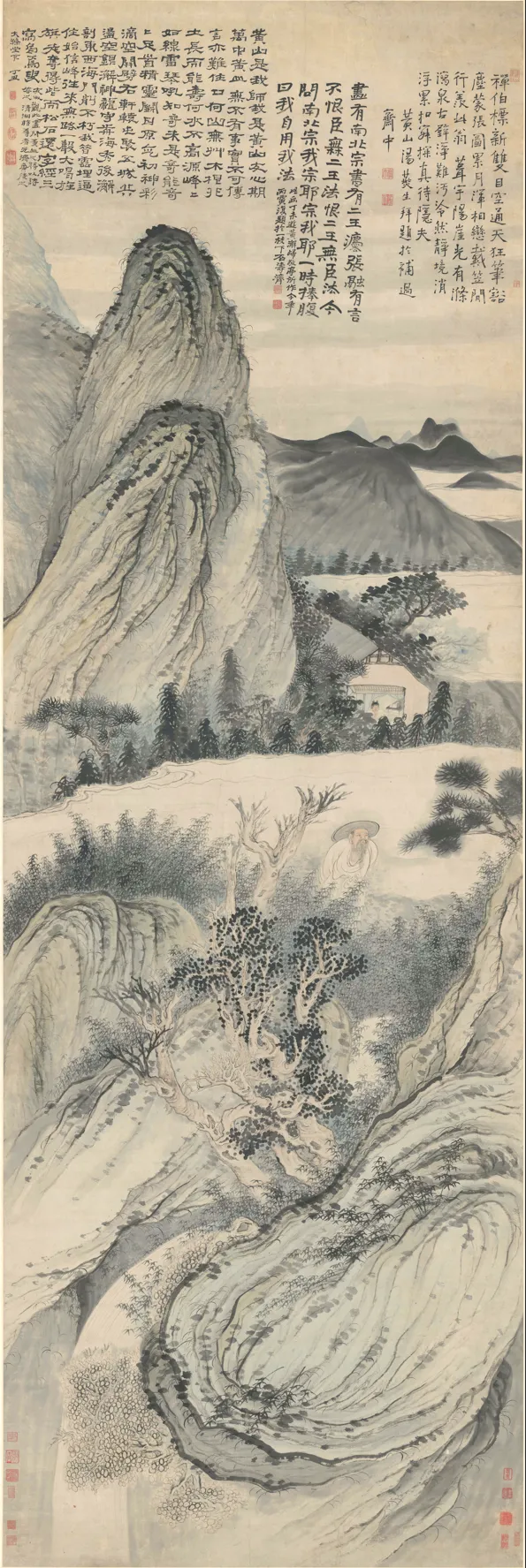
"Huangshan Mountain Landscape" by Shi Tao (1667), ink and color on paper, 350.1×116cm, collection of Liu Haisu Art Museum.
Why does Huangshan, as depicted by Shi Tao, possess such a timeless and awe-inspiring power? The answer lies deeply rooted in Huangshan's unique position within the spiritual lineage of Chinese literati. Since the Tang and Song dynasties, Huangshan has been not merely a geographical wonder, but also a pilgrimage site for the Chinese literati and a wellspring of cultural symbols. Its naturally formed granite peaks and ever-changing sea of clouds resonate deeply with the traditional Chinese philosophical concepts of "following the natural way" and "the balance of strength and gentleness." Xu Xiake, a geographer of the Ming dynasty, climbed Huangshan twice, uttering the timeless lament, "Throughout the world, there is no mountain like Huangshan in Anhui; after climbing Huangshan, there are no mountains left to climb." Painters throughout history, from Jianjiang's detached elegance and Mei Qing's exquisite beauty to Shi Tao's unrestrained style, have all regarded Huangshan as the ultimate arena for verifying their brushwork and achieving enlightenment. Thus, Huangshan transcends mere scenery, condensing into a cultural gene, a three-dimensional classic written in rocks and clouds about "contemplating the Dao with a clear mind" and "attaining the source within the heart." It stands silently, waiting for a kindred spirit to engage in a cross-generational dialogue with it.
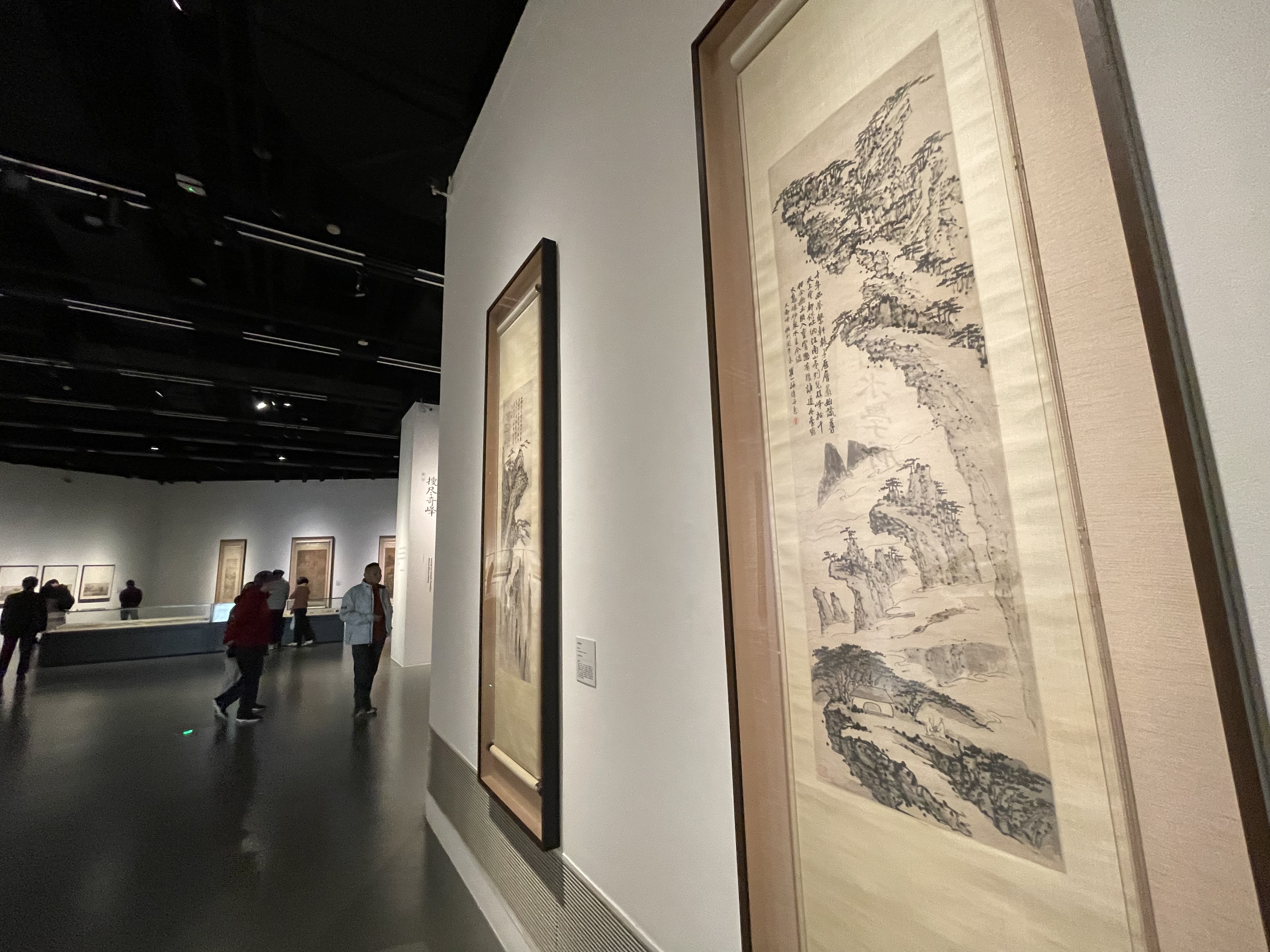
At the exhibition, Mei Qingshan Water
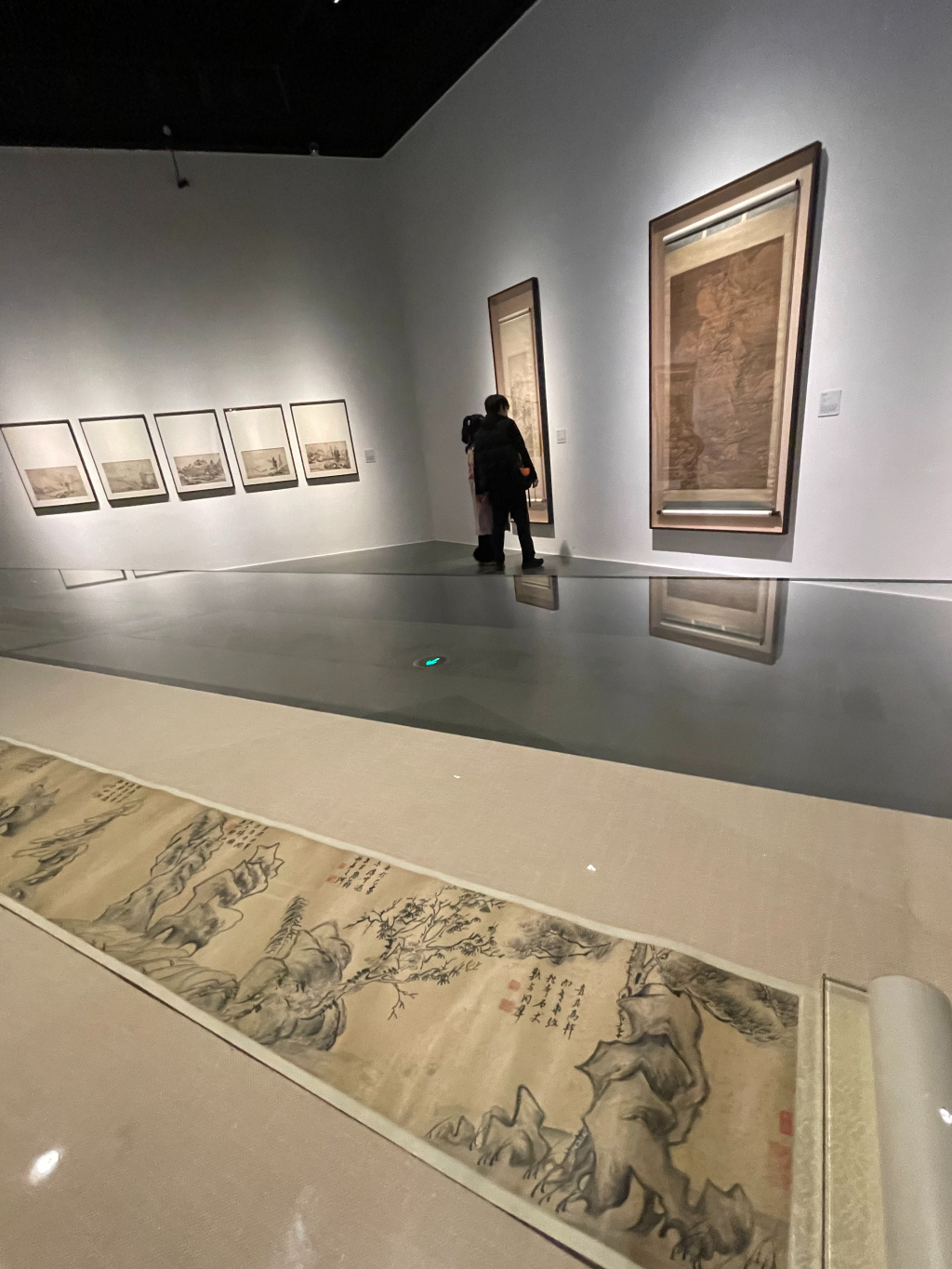
Exhibition site
The exhibition hall also displays a large number of ancient landscape treasures, most of which were collected by Mr. Liu Haisu during his lifetime, such as "Dense Forest and Layered Peaks" attributed to Ju Ran of the Five Dynasties, "Cloud and Mountain" by Fang Congyi of the Yuan Dynasty, and landscape album and handscroll by Shen Zhou of the Ming Dynasty.
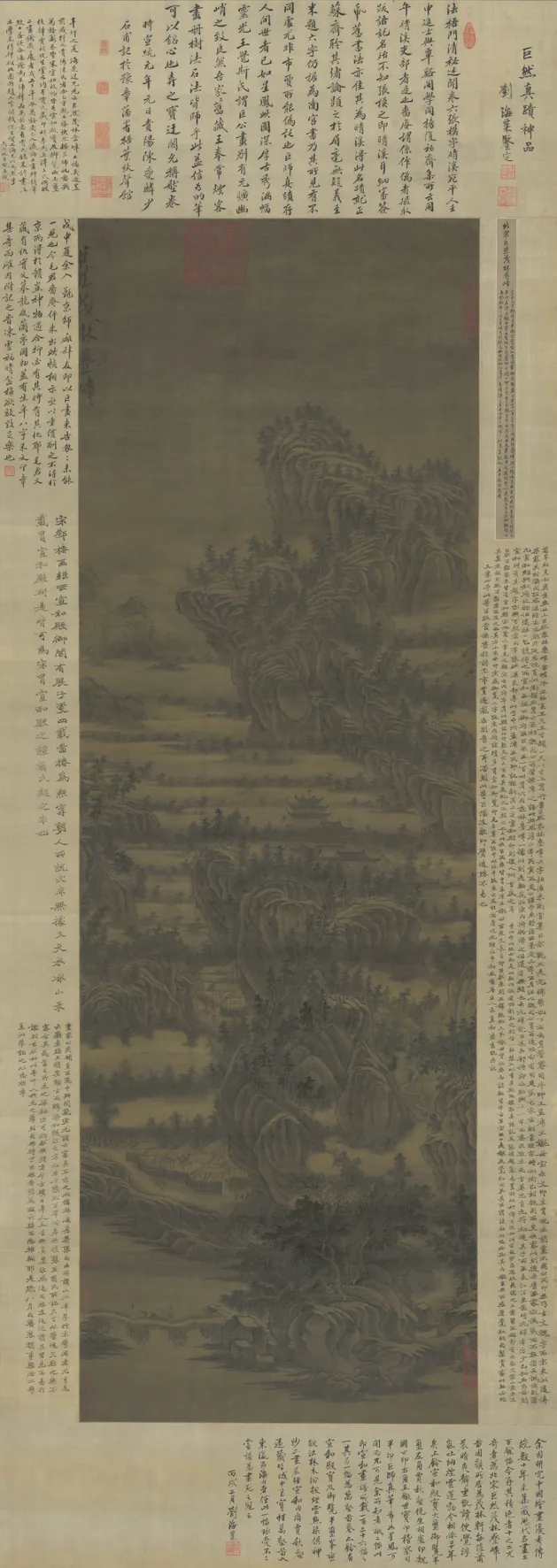
"Dense Forest and Layered Peaks" Attributed to Juran, Five Dynasties period, ink on silk, 185×60.8cm, collection of Liu Haisu Art Museum
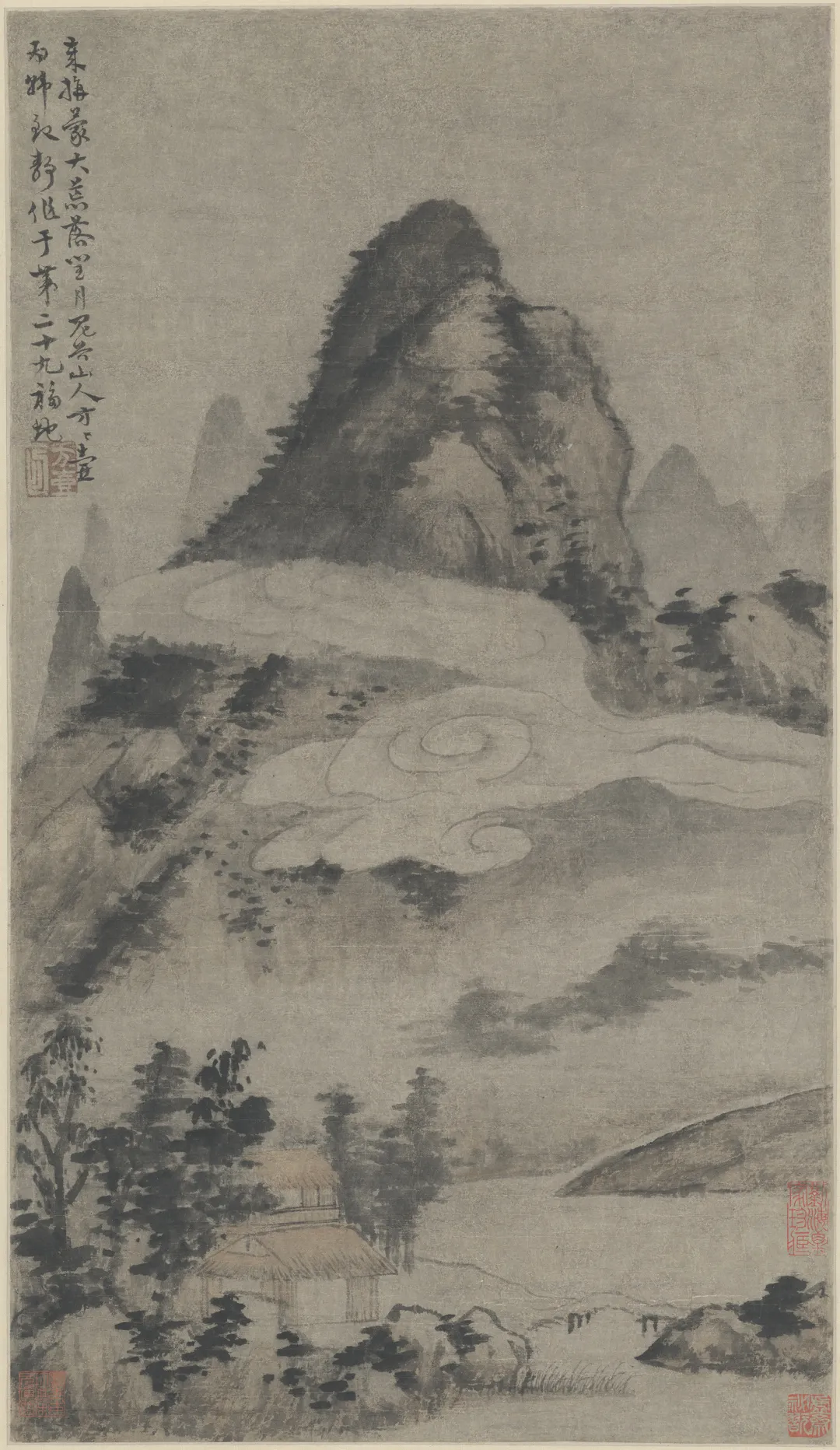
Landscape with Clouds and Mountains, by Fang Congyi, ink and color on paper, 51.5×29.6cm, collection of Liu Haisu Art Museum.
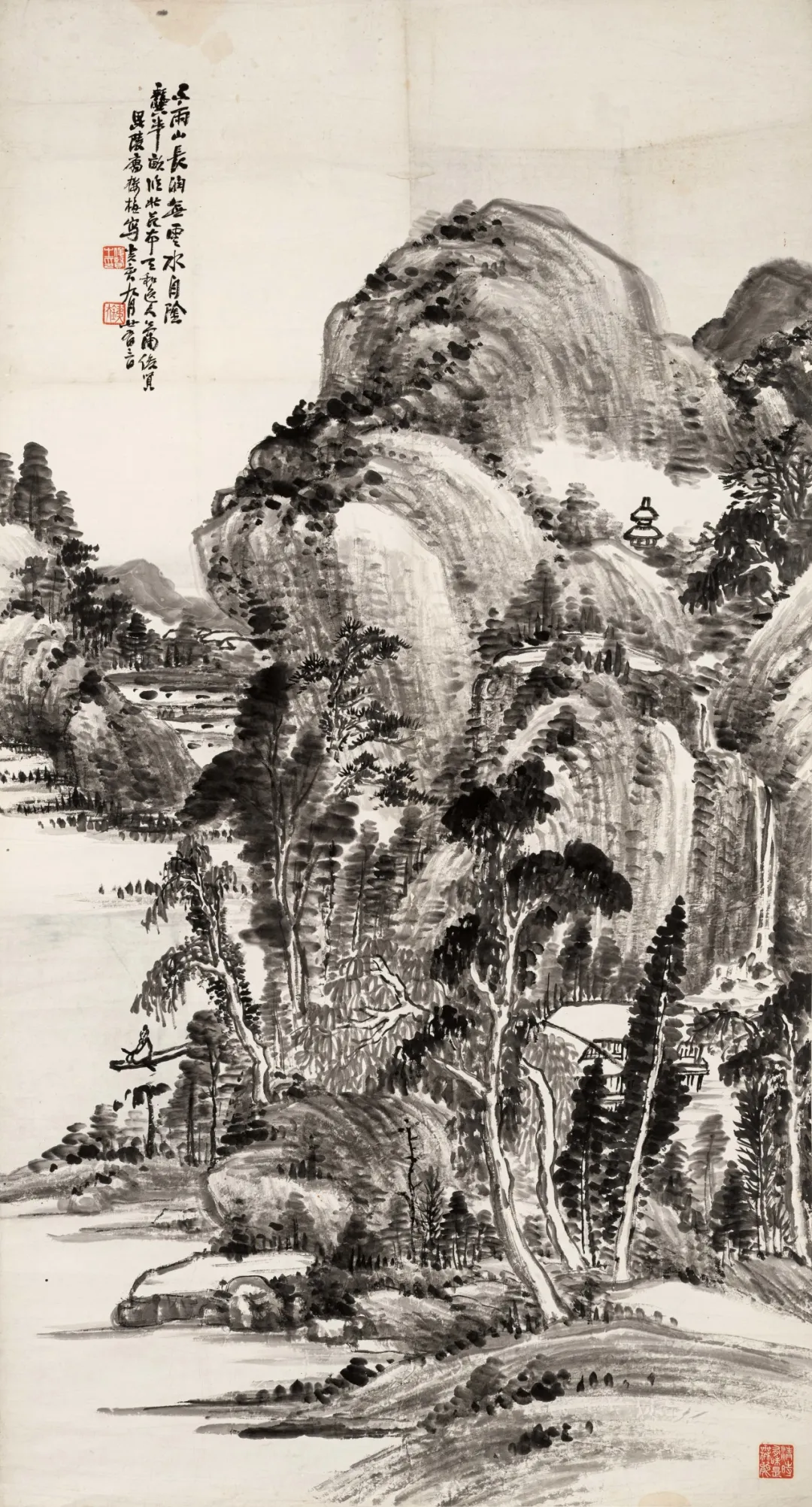
Landscape painting by Xiao Junxian, 1923, ink on paper, 150×81.5cm, private collection.
On the wall of another exhibition hall, Xiao Junxian's (1865-1949) lecture notes on traditional Chinese painting, given at the Drawing and Crafts Department of Liangjiang Normal School, quietly narrate the beginning of the "first lesson" in modern Chinese art education. Liangjiang Normal School (1906-1912) and the Shanghai Academy of Fine Arts (1912-1952), founded by Liu Haisu, are two key nodes in the history of modern Chinese art education, and there is a certain relationship of inheritance and development between the two.
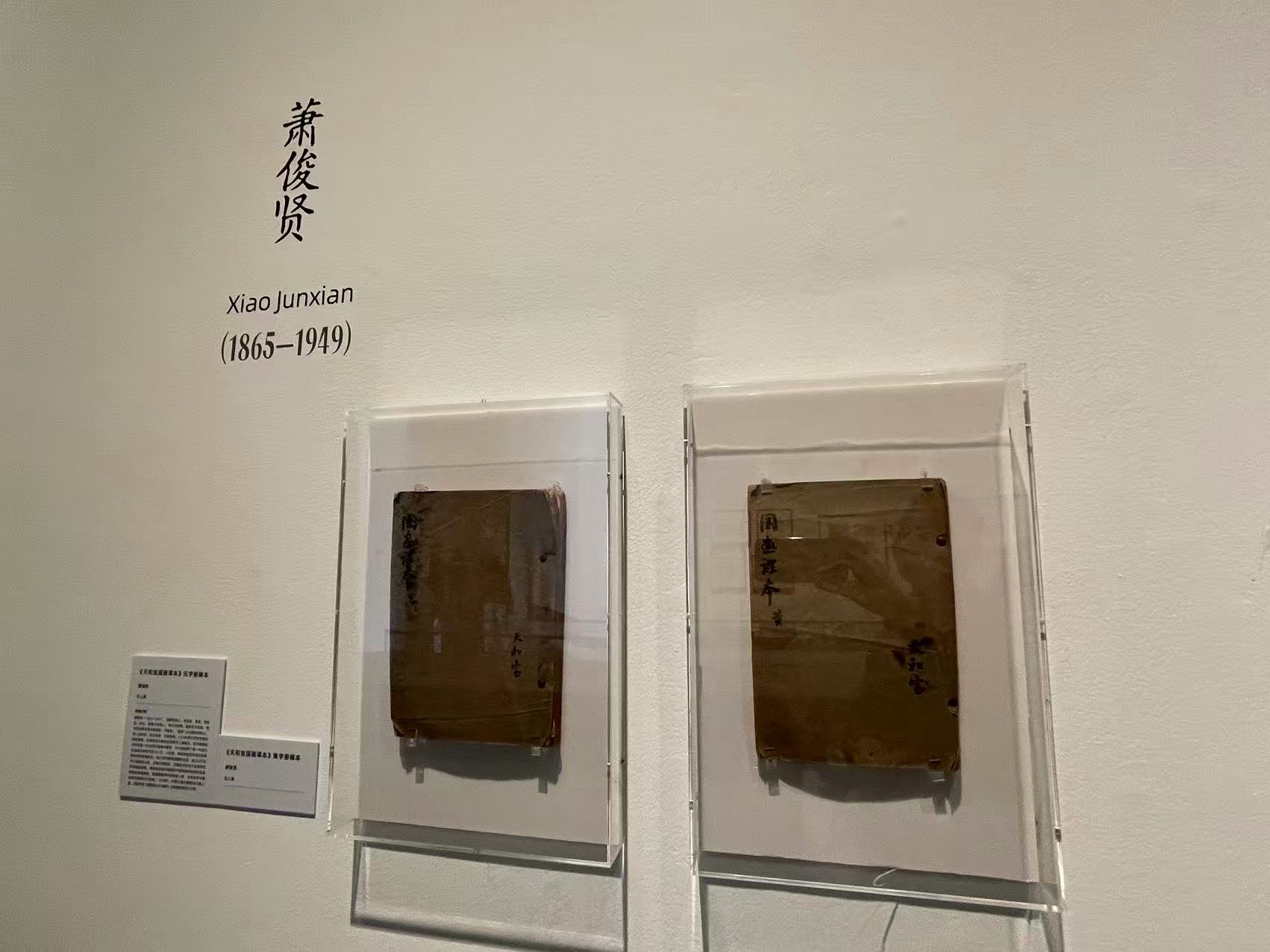
Lecture notes on traditional Chinese painting given by Xiao Junxian at the Drawing and Crafts Department of Liangjiang Normal School
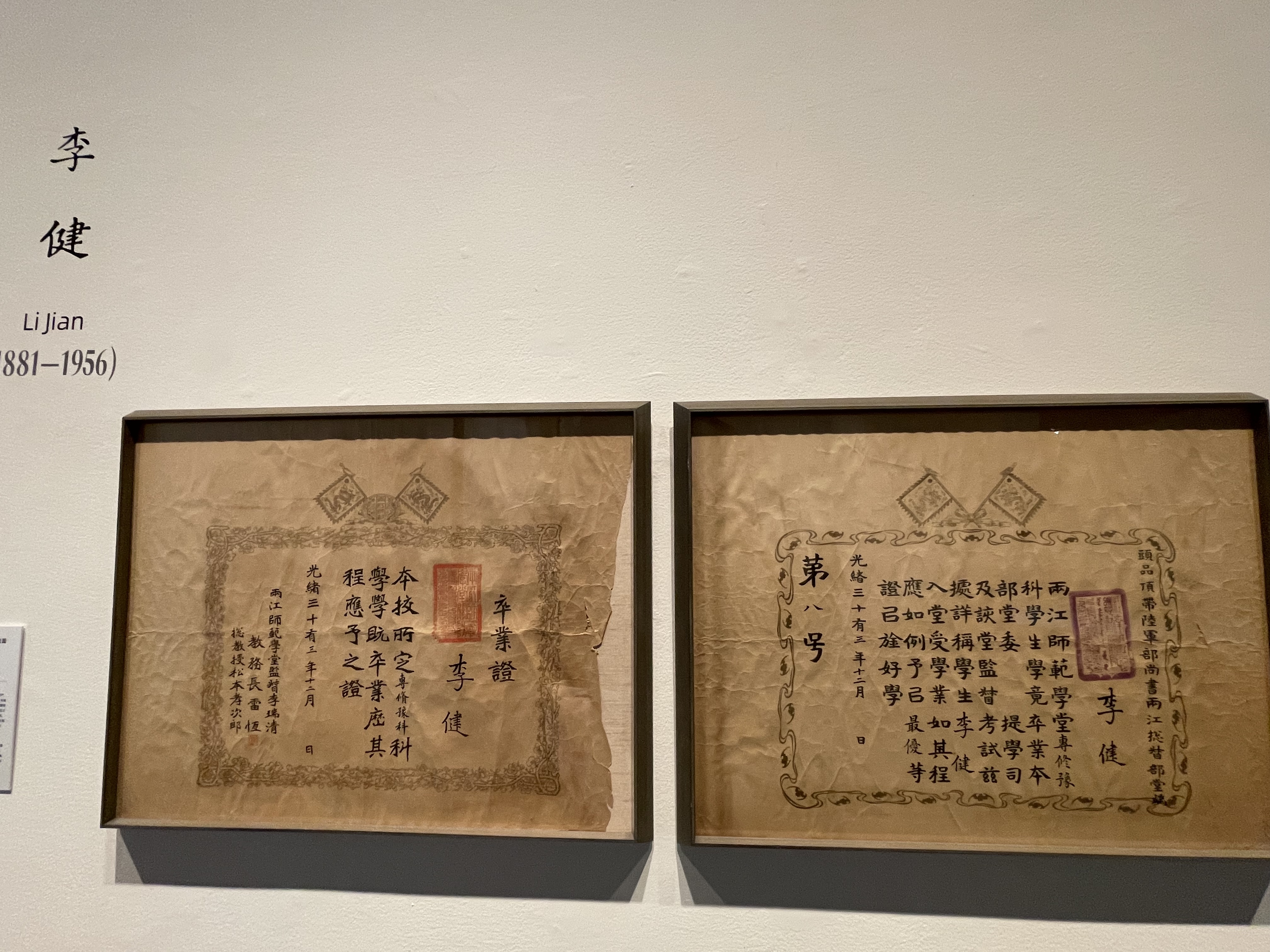
Li Jian's documents on display
Shi Tao's artistic awakening, emphasizing that "brush and ink should follow the times," evolved into a profound educational reform at the beginning of the 20th century. The exhibition uses a 1906 manuscript of "Lectures on Drawing" to guide viewers to the origins of modern Chinese art education. This manuscript, written by Xiao Junxian for the drawing and handicrafts department of Liangjiang Normal School, systematically incorporated the brushwork techniques and compositional principles of landscape painting into the modern curriculum, marking the beginning of the transformation from traditional apprenticeship-based "painting studies" to a more academic and institutionalized "art education." Exhibited alongside it are the meticulous classroom assignments of students like Li Jian, revealing the initial fusion of Western sketching observation methods and Chinese brush and ink training in their sketching and shading. This origin reveals the dual nature of modern Chinese art education: on the one hand, it inherits the ancient artistic spirit of "learning from nature," represented by Shi Tao; on the other hand, it shoulders the modern mission of "enlightening the people and cultivating new talents." Huangshan, as a dual exemplar of nature and spirit, is located precisely at the intersection of these two threads, awaiting a key figure who can transform it into modern artistic language and educational practice.
Ten Ascents of Huangshan: A Combination of Artistic Exploration and Educational Practice
Liu Haisu was precisely such a pivotal figure in the history of Chinese art, bridging the past and the future. He not only heeded the call of Shi Tao but also embarked on the path of modern art education pioneered by Liangjiang Normal School, founding the Shanghai Academy of Fine Arts. Throughout his life, he integrated artistic exploration with educational practice. Liu Haisu repeatedly mentioned the pioneering contributions of Li Ruiqing, Xiao Junxian, and others to modern Chinese art education in his articles and speeches, consciously placing the Shanghai Academy of Fine Arts within this historical context. He believed his mission was to elevate "integration of Chinese and Western art" from a curriculum method to a spirit of cultural innovation, responding to the demands of the era following the May Fourth Movement.
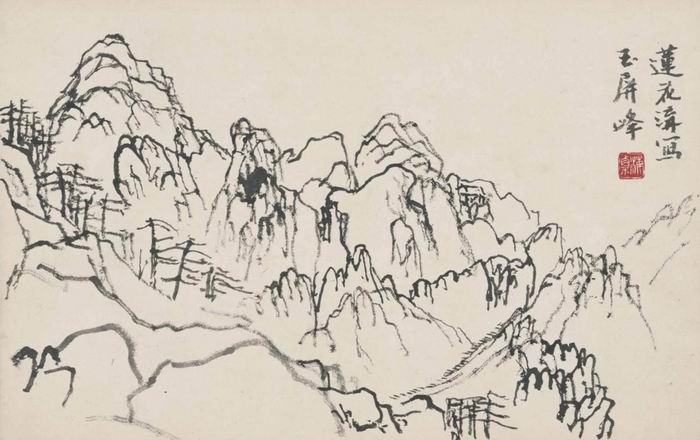
Liu Haisu wrote about Yuping Peak in Lianhuagou.
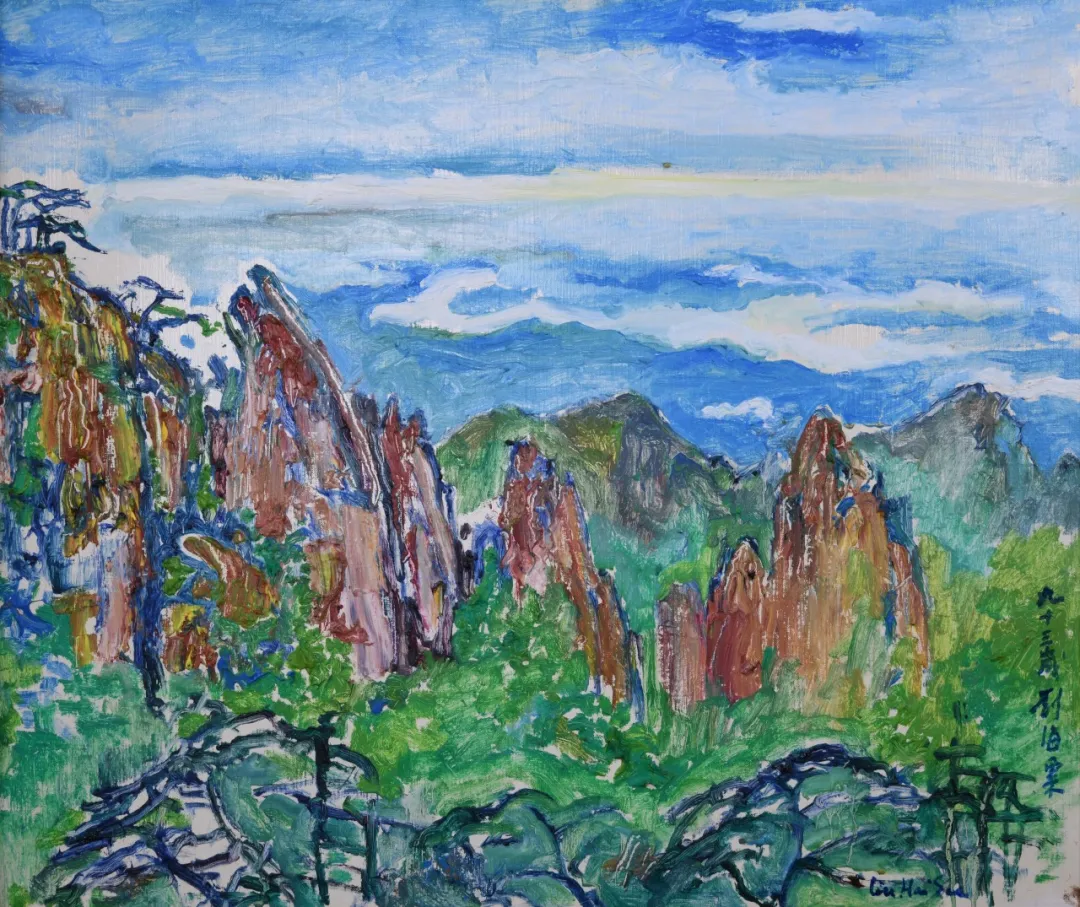
"Clouds and Mist over Houhai (After Rain)" by Liu Haisu, 1988, oil on canvas, 77.5×90cm, collection of the University Museum and Art Gallery, Hong Kong.
The chronological thread of Liu Haisu's "Ten Ascents of Huangshan" unfolds as a magnificent epic of the unity of knowledge and action. From his first exploration of Huangshan as a young painter in 1918 to his tenth ascent in 1988 at the age of 93, Huangshan permeated Liu Haisu's entire life, from innovator to master. These ten ascents are a history of the refinement of his personal artistic language: from his early study of Shi Tao's brushwork, to his mid-period reconstruction of the mountain's spirit with oil painting light and color, and finally to his late-life creation of "Grand Splashed Color Huangshan," reaching the sublime state of "doing whatever one wants without overstepping the bounds."
However, more profoundly than his personal creative work, he transformed every insight he gained from Huangshan into educational practice at the Shanghai Academy of Fine Arts. The exhibition, through rich documentation, clearly presents this trajectory: he made sketching a compulsory subject in all courses, transforming "learning from nature" from a theoretical slogan into classroom doctrine; he advocated "freedom of thought and inclusiveness," inviting numerous renowned artists to teach, internalizing the "uniqueness" and "profoundness" inherent in Huangshan into an educational atmosphere that encouraged originality. Huangshan was not only his "teacher," but also his "textbook" and "classroom."
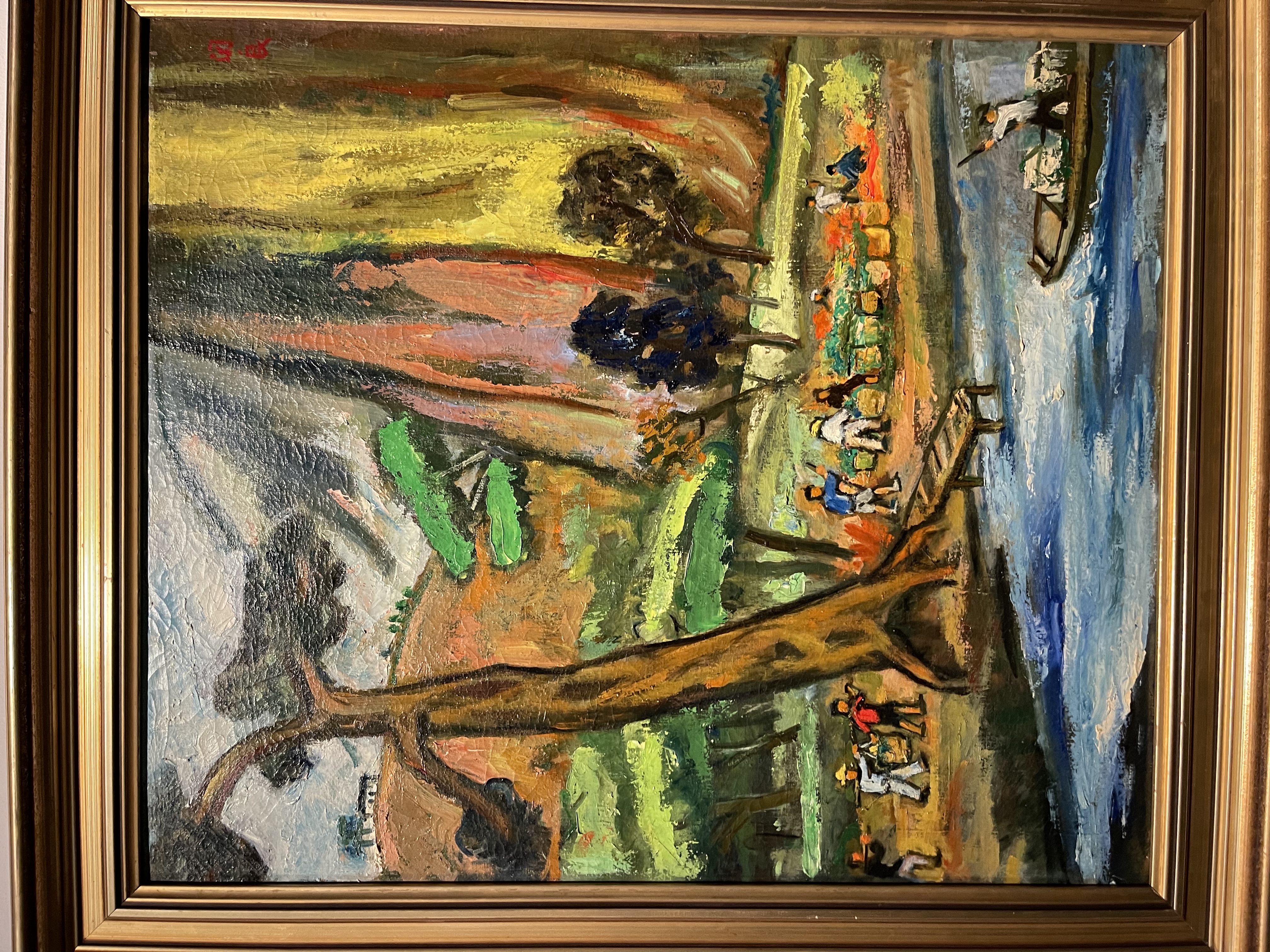
The exhibition also features landscape paintings by renowned artists such as Huang Binhong, Li Jian, Guan Liang, and Lu Yanshao. Comparing these with Liu Haisu's paintings offers a unique perspective.
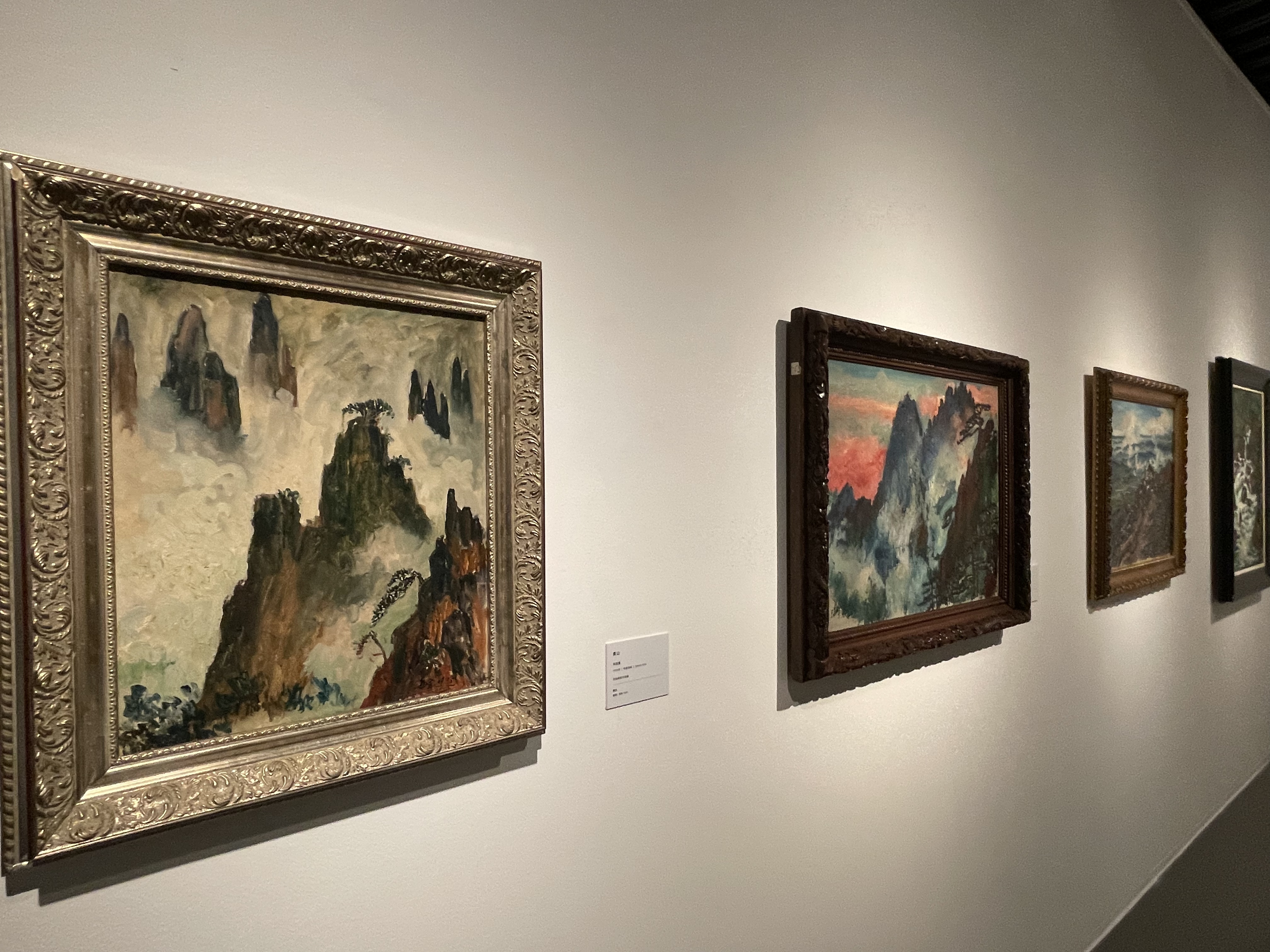
Liu Haisu's Huangshan oil paintings on display
Liu Haisu once said, "When I write about Huangshan, I am actually compiling a living textbook." His ten trips to Huangshan are also an educational epic of living and practicing the school motto of "broad, concise, profound and beautiful" with his life.
Created in 1988, "Man Jiang Hong" features mineral pigments such as cinnabar, azurite, and malachite splashed, colliding, and blending like lava, forming bold and powerful color blocks and textures on rice paper. The framework of traditional landscape painting is subtly revealed in this abstract symphony of colors. The accompanying oil painting, "Clouds and Mist over Houhai," uses a palette knife and oil paint to create the flowing texture of Huangshan clouds and mist, brimming with expressionist passion.
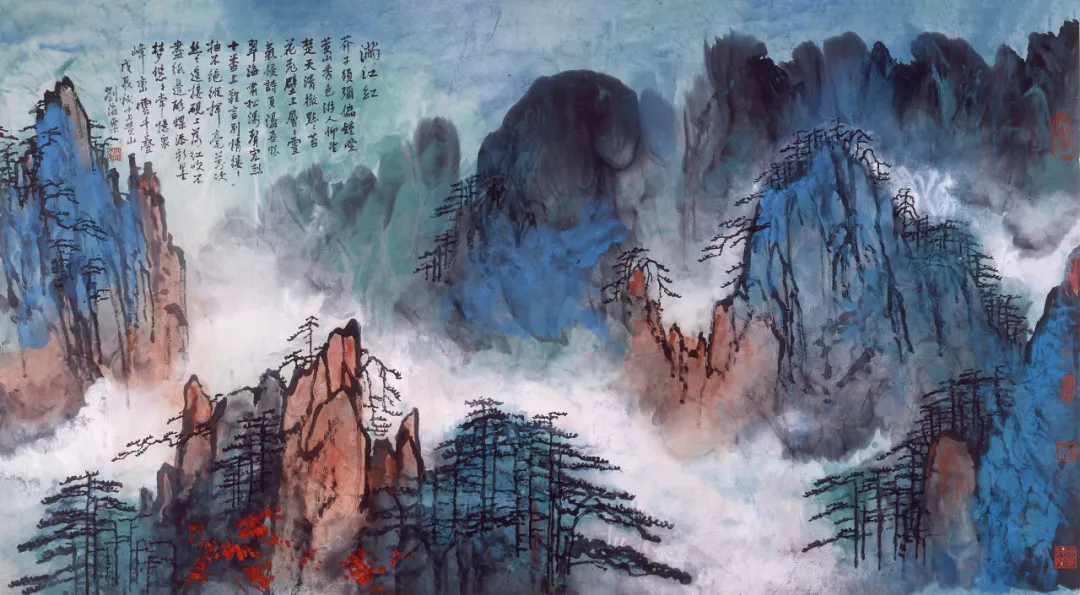
"Man Jiang Hong" by Liu Haisu, 1988, ink and color on paper, 129×244cm, collection of the University Museum and Art Gallery, Hong Kong.
Liu Haisu once said, "Huangshan is my teacher, and I am Huangshan's friend." This "teacher-friend" relationship reveals the true essence of his art: he did not passively imitate Huangshan's appearance, but rather engaged in a dialogue and creation with Huangshan on an equal footing, drawing upon all his life's passion and artistic resources from both the East and the West. In Huangshan, he saw the spirit of Shi Tao's "one stroke," and even more so, he saw the natural rhythm of heaven and earth that resonated with Cézanne's structure and Van Gogh's colors.
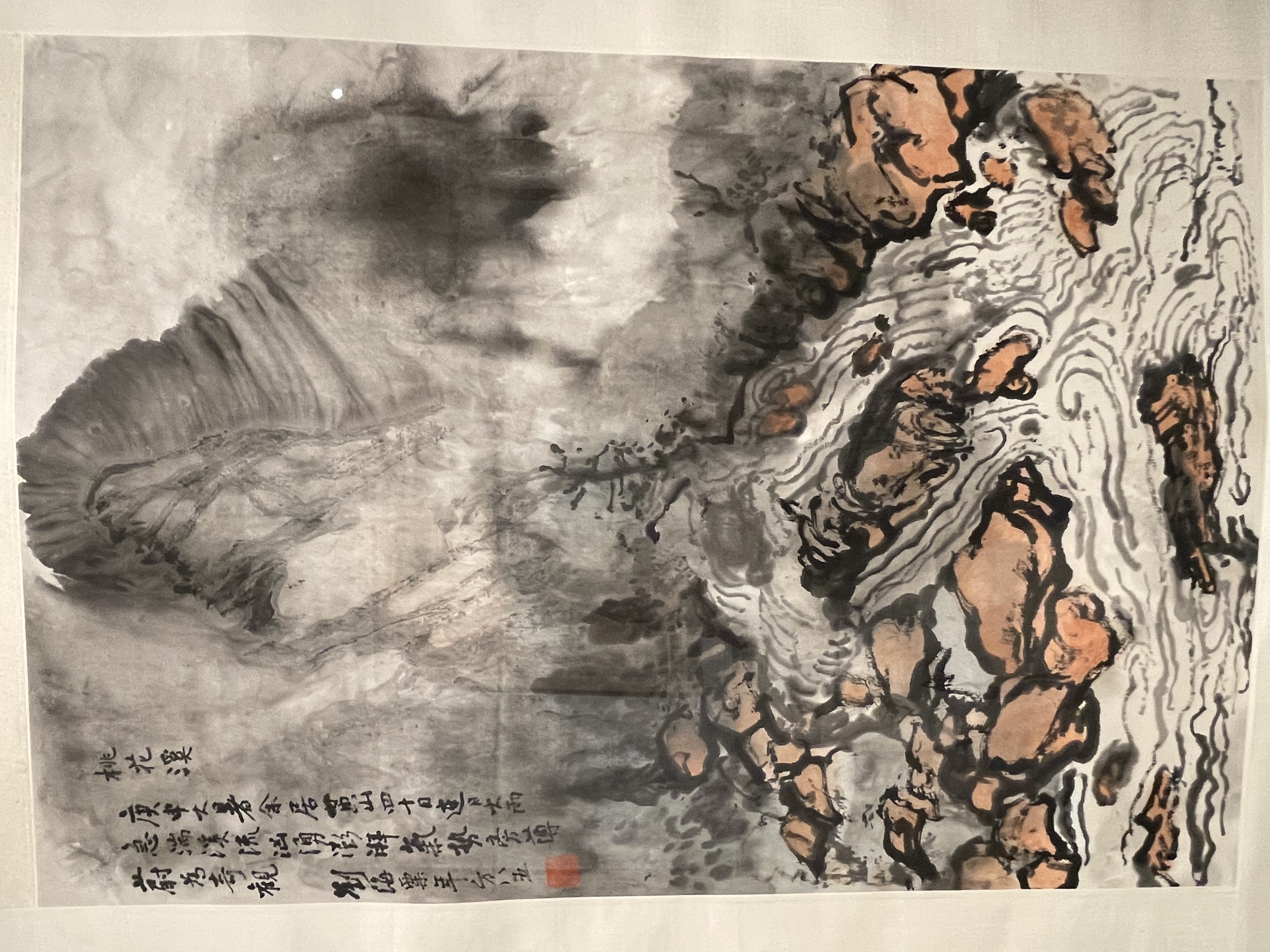
Liu Haisu, *Peach Blossom Stream*, 1980, ink and color on paper, Liu Haisu Art Museum
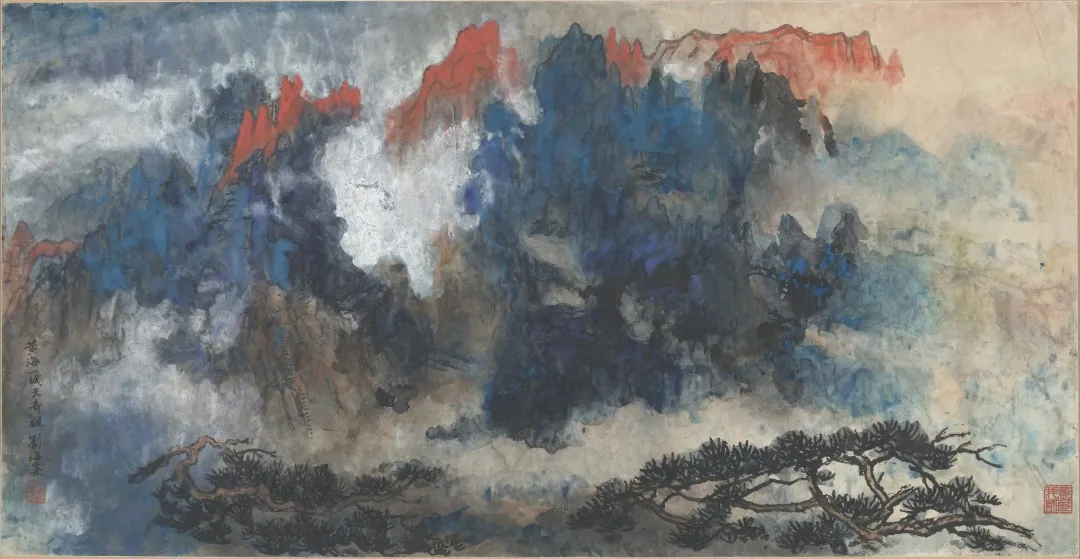
"The Spectacular Sky-Piercing Gorge of the Yellow Sea" by Liu Haisu, 1976, ink and color on paper, 69.2×134.1cm, collection of Liu Haisu Art Museum.
At the exhibition's conclusion, Chen Duxiu's inscription on Liu Haisu's "Lone Pine of Huangshan," from the collection of the University of Hong Kong Museum of Art and Design, was displayed on the mainland for the first time. Beside it is a couplet presented by Chen Duxiu from the Liu Haisu Art Museum: "With a clear conscience, one's heart is always at peace; even in hardship, one's spirit soars like a rainbow." This interplay between a leader of the New Culture Movement and an art innovator reveals Liu Haisu's exploration of art education, which is also part of the cultural enlightenment and aesthetic revolution since the May Fourth Movement. Chen Duxiu's inscription on the "lone pine," standing proudly atop the peak, is a reflection of the independent spirit and arduous pursuit of knowledge by Liu Haisu and his contemporaries.
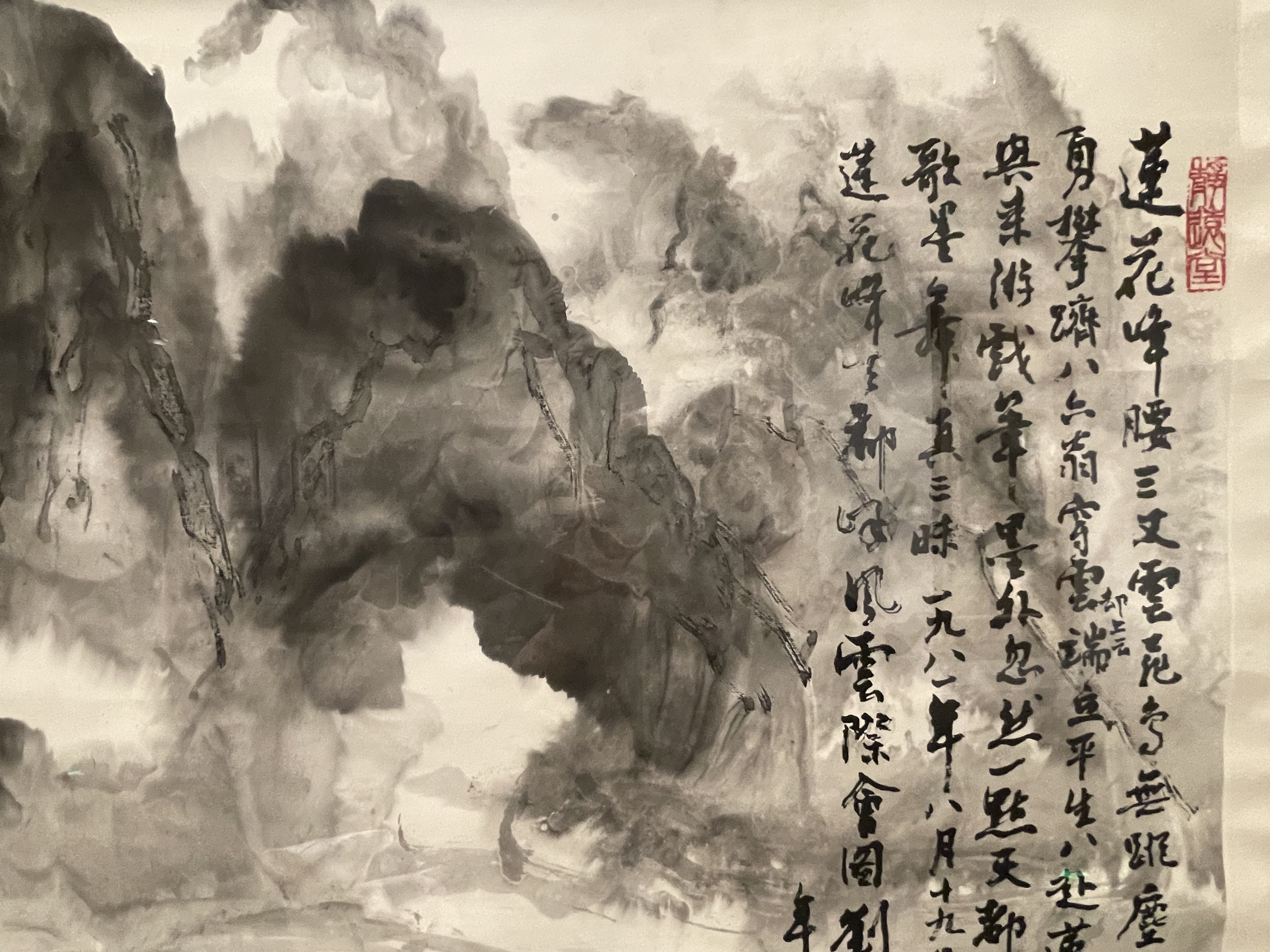
Partial view of Liu Haisu's work
From Shi Tao's "Huangshan Landscape" to the "First Lesson" at Liangjiang Normal School, from Liu Haisu's ten visits to Huangshan to the curriculum system of the Shanghai Academy of Fine Arts, a clear "landscape painting lineage" is revealed: it is not only a continuation of the Chinese literati's spirit of "purifying the mind and observing the Dao" in their brushwork, but also a creative process of this spirit being transformed into educational systems and aesthetic education concepts in modern society. Liu Haisu's later-life concept of "borrowing from the past to open up the present, integrating Western and Chinese elements" is not only a summary of his personal art, but can also be seen as the crystallization of this lineage in the 20th century.
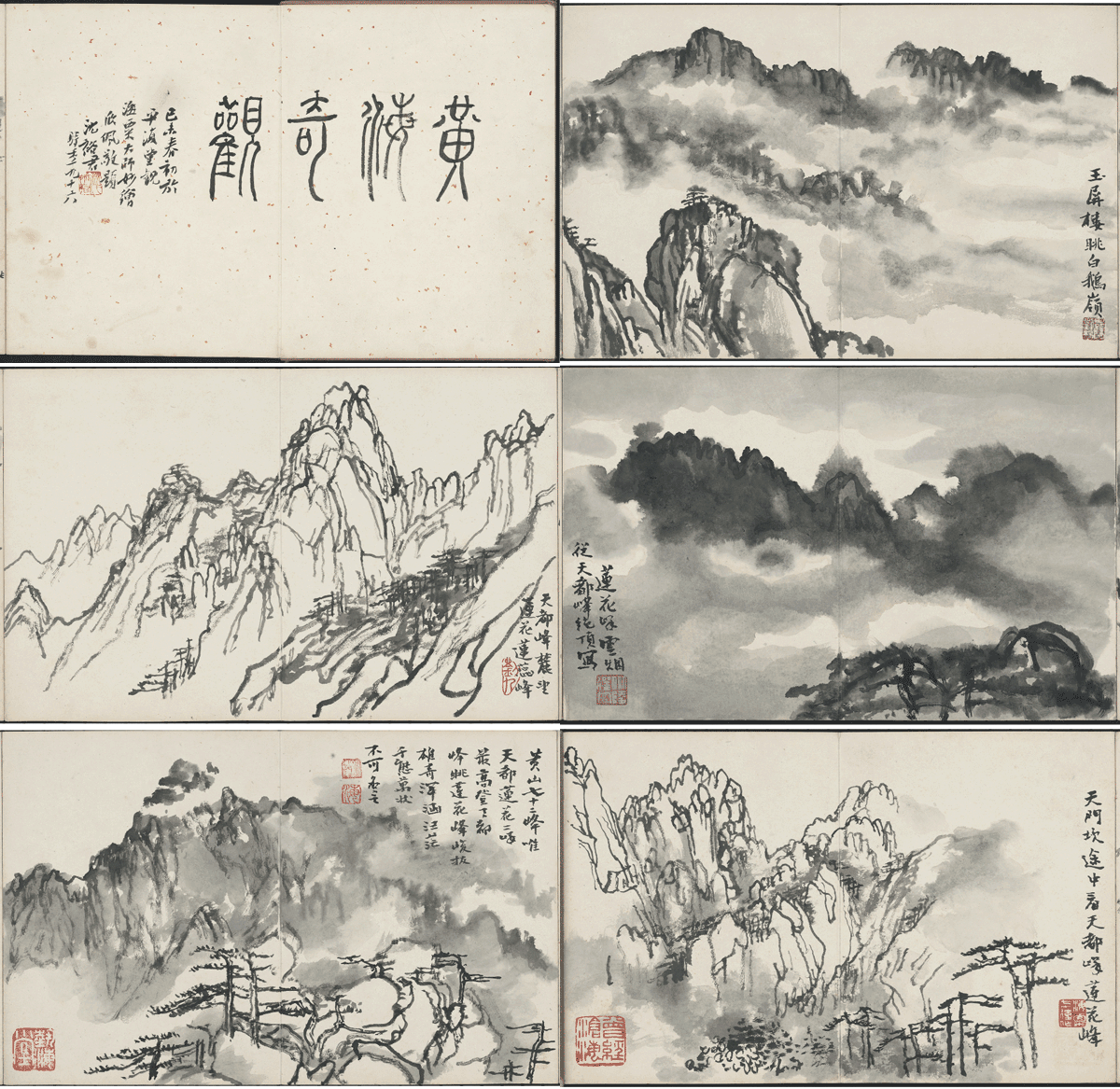
Liu Haisu's Chinese painting sketches, "Spectacular Scenery of the Yellow Sea" album
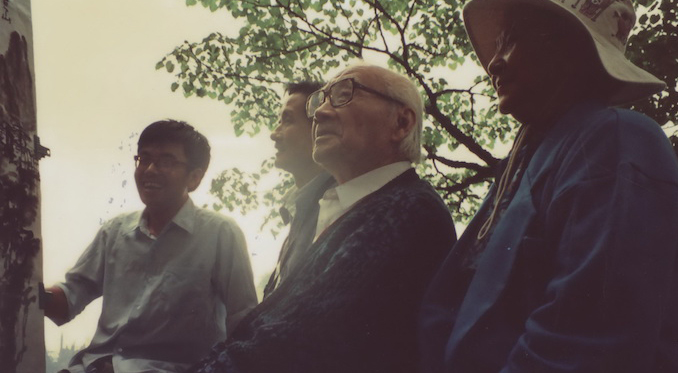
Photo of Liu Haisu's tenth ascent of Huangshan in 1988.
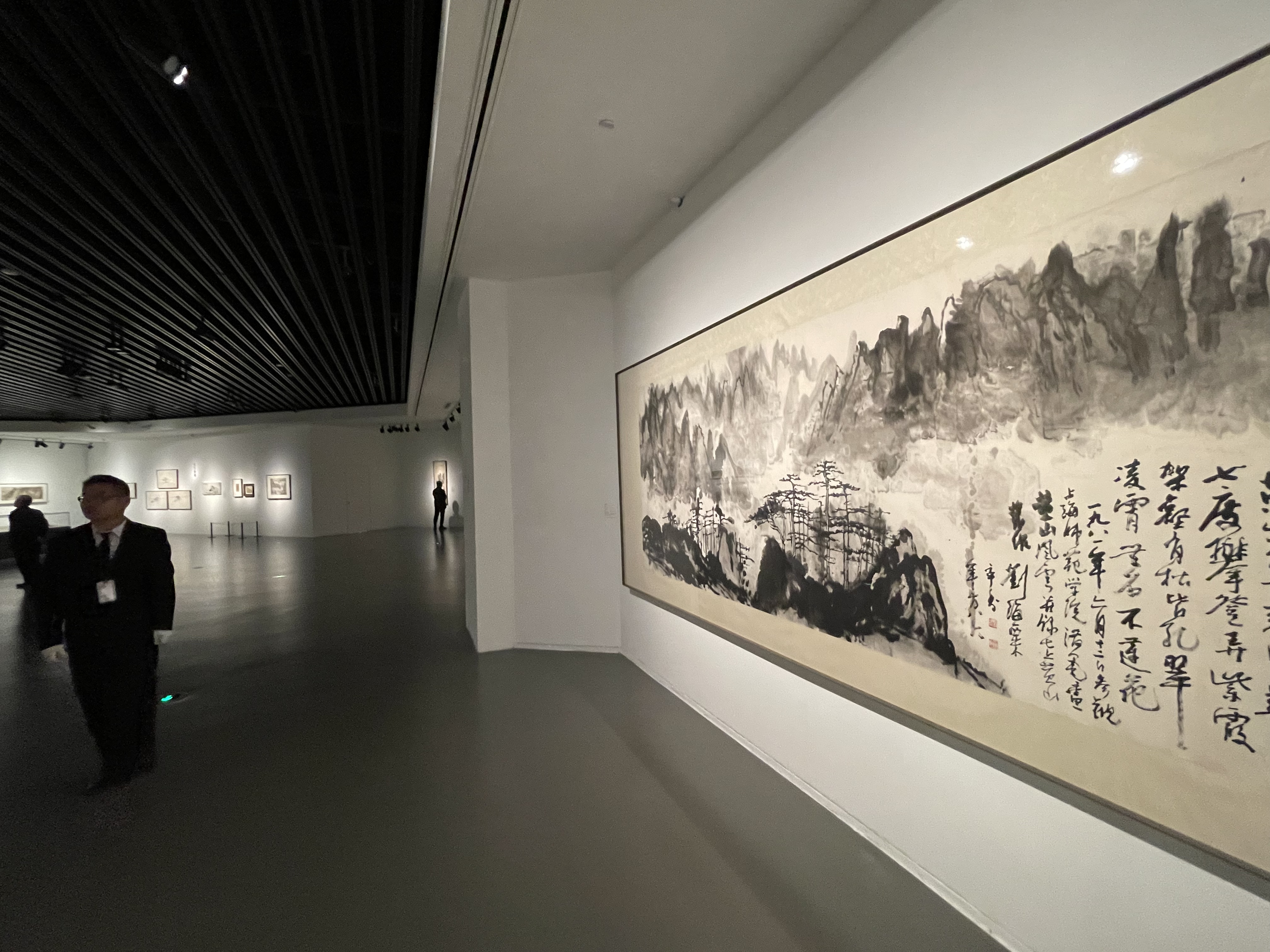
Exhibition site
This exhibition will run until February 1, 2026.